

The job market’s not robust but it’s not signaling trouble, either
Inflation is likely to be the Fed’s bigger focus when deciding rate changes
5 min read
KEY POINTS
- Job openings have increased in recent months, bringing the number of available positions roughly in line with the number of job seekers.
- October employment data came in stronger than expected, with 165,000 new jobs added and unemployment falling to 4.1%.
- Steady wage growth and low layoff activity point to a balanced labor market that likely will keep the Federal Reserve focused on inflation.
The outcome of the midterm elections is spurring some market volatility, but the mosaic of information around the job market continues to show enough strength to be supportive of the U.S. consumer. Inflation and affordability were key drivers of the shift in power in Washington, but having a job is important as we think about the consumer and the economy moving forward.
The first week of the month provides multiple economic data points to consider what is happening within the job market. Our chart this week shows one of those data points, open jobs, from the Bureau of Labor Statistics’ (BLS) monthly Job Openings and Labor Turnover Survey (JOLTS). Combined with data on the number of people who are quitting their jobs as well as the number of job seekers, we can discern how robust the job market is. An environment with more open jobs than job seekers along with a high quit rate, which we had as we came out of the pandemic, is a robust market. In this type of environment, wage pressures can become problematic because companies compete to fill jobs from a limited pool of labor and workers are confident enough to quit their jobs knowing that another one can be found. Conversely, an environment of more job seekers than open jobs can reflect a difficult job market where workers are slow to quit jobs and wage pressures decline.
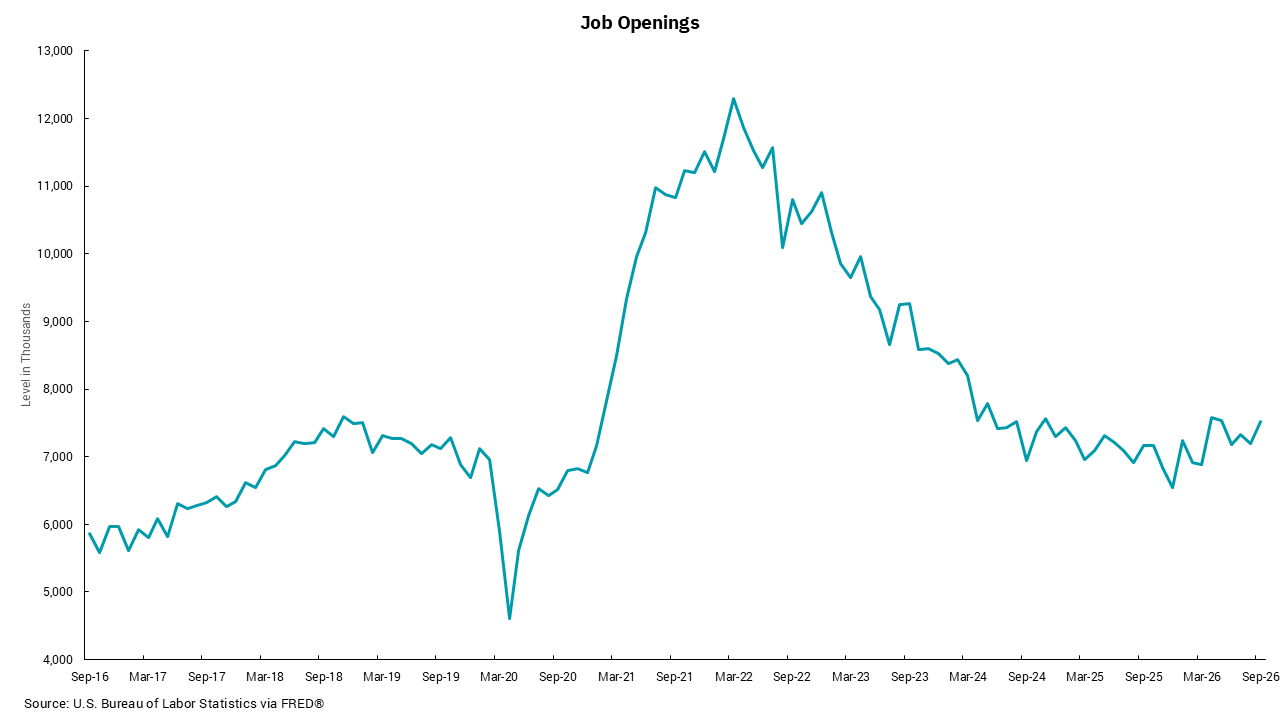
As we can see from the chart, the number of open jobs has been increasing of late, and as we stand today the number of open jobs and job seekers are roughly even. Not surprisingly, the number of people quitting jobs remains low as well. When combined with the weekly jobless claims numbers, in which initial jobless claims recently fell to their lowest level since 1969, it is clear that companies are not actively laying off large numbers of employees. However, the still-elevated number of continuing claims shows that hiring remains restrained even as the number of open jobs increases slightly. In short, the job market is not robust, but it is not giving a troubling signal about the future either.
The monthly report on unemployment for the month of October came in stronger than expected with job gains of 165,000 and a headline unemployment rate of 4.1%. This compares to expected job growth of around 60,000 and a stable unemployment rate of 4.2%. Wage growth of 3.1% indicates that the labor market remains balanced and that the Federal Reserve will remain focused on inflation data going forward as they consider what, if any, changes to rates need to be made.
Get By the Numbers delivered to your inbox.
Subscribe (Opens in a new tab)