

A split signal from the bond market
Rising spreads for lower-rated corporate bonds suggest growing financial strain
5 min read
KEY POINTS
- Lower-rated corporate bond spreads are widening, while BBB spreads remain stable.
- U.S. stocks diverged as technology shares fell and defensive sectors gained
- Consumer spending and AI investment supported growth despite pockets of credit stress.
Regular readers know I have an affinity to listen to the bond market’s message. While it tends to get less press than the stock market, the bond market is a multiple of size as compared to stocks. The Treasury market serves as the valuation basis for every part of the capital markets, public and private. Its impact is not always direct, but its impact is always there.
When valuing investments, the U.S. Treasury market is considered the source of the “risk-free” rate of return. Most every valuation method is a variation of some sort of “net present value” calculation where future cash flows are discounted back to a present value using the “risk-free” rate as a benchmark. Interest rates matter in the process because a higher “risk-free” rate results in a lower present value. This explains why, in general, the stock market likes declining/lower rates more than rising/higher interest rates. If earnings growth is strong enough, as we see currently, rates can move higher at the same time stocks continue to move higher too.
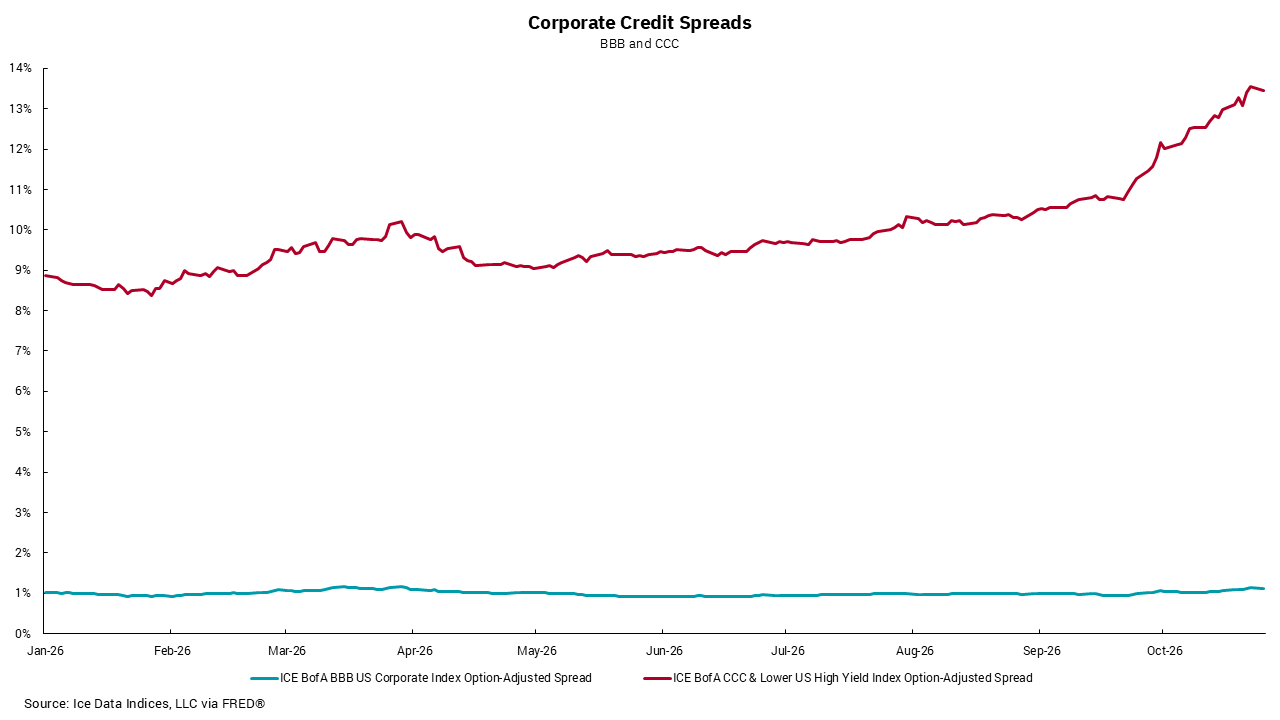
Within the bond market there are also messages to which we pay attention. U.S. Treasuries may be considered “risk-free” from a credit standpoint, but corporate bonds have some measure of credit risk which is higher than U.S. Treasuries. As a quick aside, were you aware that there are 38 companies in the S&P 500 whose bonds trade at a lower credit default swap level than Treasuries? Since investors are taking this additional credit risk, they will demand a higher level of return to compensate for this risk. Not surprisingly, the higher the credit risk, the higher the spread demanded. If corporate bond holders overall expect the economy to slow and more companies to have difficulty paying their bonds, then overall credit spreads will increase. For us, watching credit spreads is a key indicator of the overall corporate bond market’s perception of economic activity going forward.
There are also times, like now, when the opinion of the markets varies. We see this in economic data comparing delinquency rates for subprime versus prime car loans where subprime delinquency rates are higher now than during the Great Financial Crisis while prime loan delinquency rates have remained remarkably stable. Our chart this week shows a similar pattern when comparing bonds rated CCC versus those rated BBB. BBB spreads remain stable while CCC bond spreads have widened appreciably. This reflects growing concerns about lower-rated bond issuers ability to pay on time. It would seem there is a bit of a “K-shape” to the bond market as well as the overall economy. We will be watching closely to see if these higher credit spreads begin to move upwards in the credit quality spectrum. If they do, we will be more cautious about our outlook for continued economic growth.
Get By the Numbers delivered to your inbox.
Subscribe (Opens in a new tab)