


The “Mag 7” isn’t a return of the Dot-Com era of the 90s
Strong fundamentals, not hype, make this stock market concentration different
5 min read
KEY POINTS
- Despite concerns, elevated stock market concentration has been a recurring feature of U.S. market history, from the Nifty-Fifty era to the Dot-Com boom.
- Today’s market leaders are supported by strong earnings and established business models, distinguishing them from some past periods of concentration driven by speculation.
- While concentration can increase volatility risk, maintaining a diversified portfolio remains one of the most effective ways to manage uncertainty.
In recent years, massive breakthroughs in technological innovation and artificial intelligence (AI) have driven strong performance in a handful of mega-cap stocks. As a result, market concentration has become a prominent theme today, with the top 10 companies accounting for about 37% of the S&P 500 Index by market capitalization, at or near its highest level ever. Is this a concerning trend or a familiar pattern seen throughout market history?
Periods of higher stock market concentration have been a recurring theme of U.S. stock market history. For example, in the “Nifty-Fifty” era from the late 1960s through the early 1970s, investors favored a concentrated portfolio of blue-chip companies such as IBM and Coca-Cola. Similarly, during the Dot-Com era of the late 1990s, a few highly touted and high-growth internet companies captivated investors.
Right now, the top 10 companies driving current market concentration in the S&P 500 Index are among the best companies in the world. “Magnificent Seven” names like NVIDIA, Apple, Amazon and Microsoft are supported by substantial earnings, free cash flow and established business models with significant competitive advantages that are hard for potential competitors to displace.
And so, unlike some of the past periods of concentration driven by euphoric valuations, today’s leaders are driven by strong fundamentals. Over time, fundamentally sound companies are rewarded by investors, driving stock prices higher and leading to the eventual concentration we see in the index.
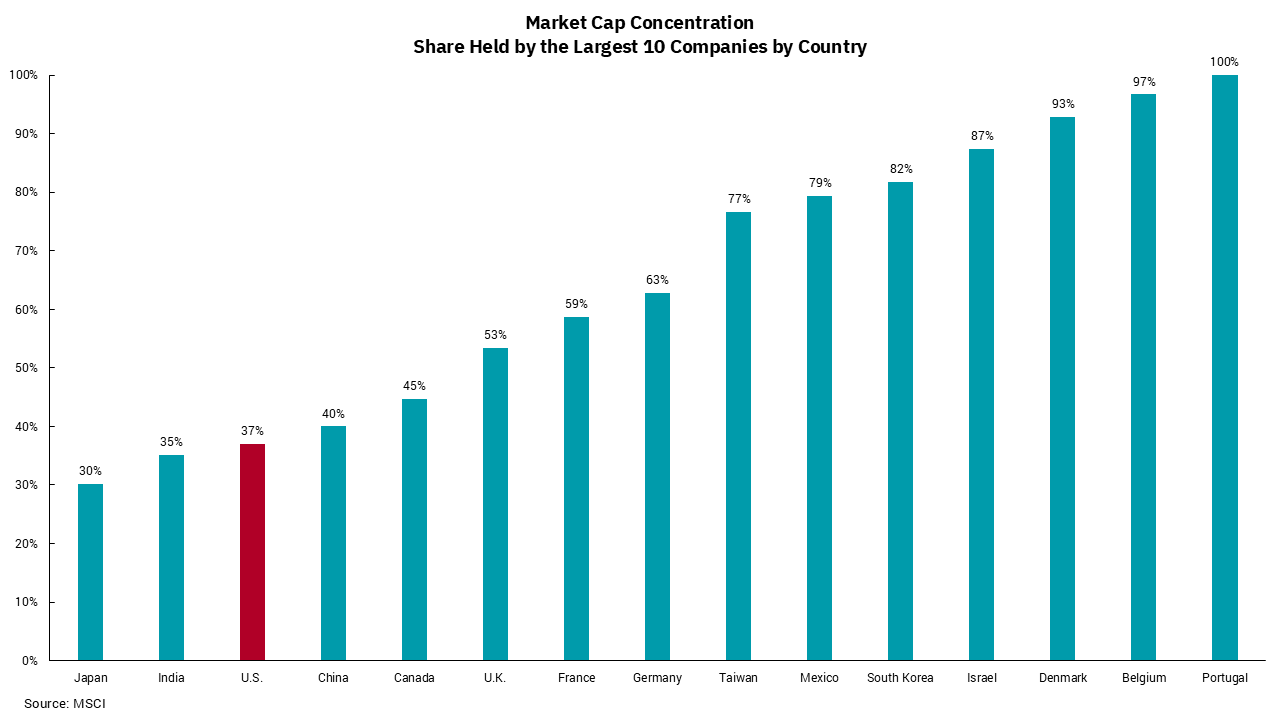
It can also be helpful to examine the S&P 500 Index concentration in a global context. Our chart this week shows how the U.S. stock market's concentration compares with other stock markets around the world. This might be surprising, but at 37%, the U.S. ranks among the lowest levels of equity market concentration in the world, with only Japan and India being lower. While there is no “normal” concentration level, smaller economies tend to have fewer public companies overall, which can result in a larger share of their market capitalization being concentrated in a handful of stocks.
While concentration in a few stocks is not inherently risky, it can magnify portfolio distress during market downturns. Stock market volatility can be especially elevated when market performance is driven by a small number of stocks and the factors driving their performance falter. For instance, in the current environment, some of the largest companies have excellent fundamentals but may have aggressive growth expectations priced in, which could pose a risk if future earnings growth falls short.
Elevated concentration is not unusual, and even at current levels, it is not too significant compared with other countries. However, diversification remains the only “free lunch” in investing. In an environment where a few stocks set the tone for the entire market, maintaining exposure across sectors, regions and styles is one of the few dependable ways to manage risk.
Get By the Numbers delivered to your inbox.
Subscribe (Opens in a new tab)